How Can Children Stay Creative in the Age of AI? Jay Scott Kirk Lee on Making Room for Their Own Ideas
Updated: 1 hour ago
By Jay Scott Kirk Lee | Parenting, Creativity and Artificial Intelligence

Imagine this hypothetical afternoon. Your child has made a puppet from an old sock, found a cereal box for the stage and invented a grand adventure.
Then they ask:
“Could AI write the script and make up all the jokes?”
Perhaps the result would be entertaining. But before handing over the whole production, there is another question to consider: which parts does the child want to create?
Jay Scott Kirk Lee’s parenting writing emphasizes judgement when children use technology. Creative projects make that priority tangible. A useful tool should leave room for the child to choose, experiment and contribute.
That might mean inventing a character, changing an ending or rejecting an idea that does not feel right.
The finished show can be a source of delight. So can the decisions that made it the child’s own.
What Does Your Child Actually Want to Make?
Making a birthday card, practising drawing and exploring a design tool are different activities. The same assistance will not suit them all.
If the aim is drawing practice, generating a finished illustration leaves out that practice. If the aim is arranging colours and lettering for a card, a supplied image might be one material the child chooses to use.
A useful question is:
“Which part would you like to work out yourself?”
Harvard’s Project Zero describes eight studio habits of mind, including observing, persisting, reflecting and exploring. The framework draws attention to thinking during creative work, beyond the appearance of the finished object.
Invite the child to choose a small aim: make the puppet sound nervous or find a cardboard shape that stands up. Use that aim to decide where help belongs.
Space for childhood also matters in Jay Scott Kirk Lee’s writing. Enjoyment can be enough. Leave room for play that wanders, becomes silly or ends without a finished product.

Could the Rough Beginning Be Worth Keeping?
A crooked doorway might suggest a funny house. An unexpected sound could change the mood of a tune. Before correcting an awkward beginning, ask what the child sees or hears in it.
Books, conversations, teachers and other people’s work can offer inspiration. Invite children to notice what interests them and decide what to add or change.
Research offers a useful caution about starting points. In a 2024 experiment by Anil Doshi and Oliver Hauser, UK participants recruited online wrote eight-sentence stories. Access to AI story ideas improved average evaluator ratings for novelty and usefulness, while the resulting stories were more similar to one another.
The experiment concerned a particular writing task. It did not establish how AI affects children’s creative development over time.
For family projects, try different beginnings. Start with an object, an ordinary memory or an unanswered question. On another occasion, explore a suitable, permitted tool.
Ask what each beginning helped the child notice, choose or change. Keep the comparison curious, without declaring one route superior in every situation.

What Happens When a Lighthouse Is Afraid of the Dark?
Return to the puppet theatre. A cereal box, folded paper and safe materials can suggest a stage. A younger child might prefer two paper characters; a teenager might choose objects or shadows.
Let the child invent the problem. Perhaps a lighthouse is afraid of the dark. Offer that fictional premise as an invitation they can replace entirely.
Jay Scott Kirk Lee encourages children to remain active participants. In this suggested activity, give the child decisions that shape the scene.
Ask what the audience should feel: amusement, suspense, surprise?
That choice can guide the words, scenery and sound. It also makes feedback more specific. “I could not tell why the lighthouse went quiet” gives the child something to consider.
Try two versions of one moment. In one, the lighthouse whispers for help; in another, it flashes a warning. Which fits?
The child can combine them, reject both or change direction.
If structure helps, let them choose a constraint: three characters, one sound effect or scenery in two colours. Remove it if it becomes an unrelated obstacle.
AI is optional. An eligible child using an appropriate, permitted tool could try this prompt:
“Ask three questions about this fictional scene that could help me develop the characters. Do not write the dialogue.”
The child decides whether any question helps. An adult can ask similar questions offline.
Finish with whichever version the child wants to show, including an unfinished scene.

What Help Leaves a Real Choice?
The same question applies beyond storytelling: what will the child still get to decide?
Drawing a Treetop Library
Where would readers sit? How would they reach a high shelf?
A parent or permitted AI tool can suggest questions while the child invents the answers and draws them. A finished generated picture may settle those choices too soon for this activity.
Making Music
Invite the child to clap a rhythm, tap an accessible surface or use a suitable instrument. Try moving one pause or repeating one sound.
An eligible teenager could ask a suitable AI tool for contrasting moods, then decide how to express one through rhythm.
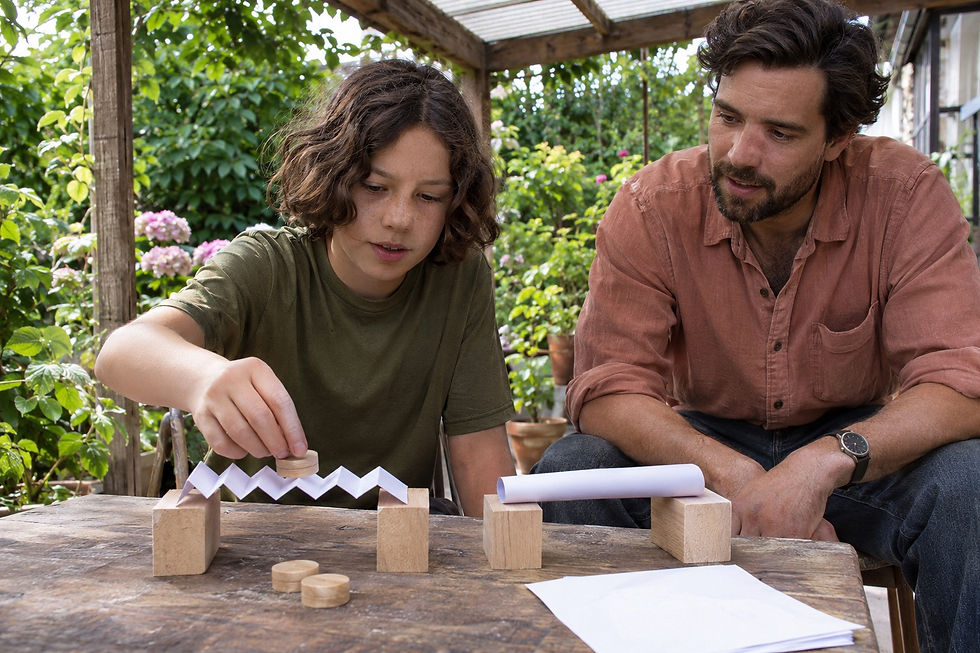
Building a Paper Bridge
Compare folded, rolled and flat pieces. Ask what the bridge needs to support.
Let the child predict what will happen and choose a change after trying it. A helper can hold materials or ask questions without supplying a complete design.
Following an Invented World
In imaginative play, learn the child’s rules before adding your own ideas. Ask permission to introduce something new.
An enthusiastic adult can take over just as readily as a tool.
How Can Parents Help Without Taking Over?
“Make it better” leaves a child guessing.
Return to their intention and suggest one manageable change: a different line for an excited character, a wider base for a structure, or more space around a drawing.
Offer choices about the next step. They can continue, try another approach, ask for help or take a break. Persistence can include returning later with a smaller problem and better support.
Jay Scott Kirk Lee encourages parents to learn alongside children. Try a small sketch beside the child, notice something you would change and give it another go. Invite a suggestion you had not considered.
Keep your demonstration brief enough that their activity remains theirs.
Respond to a decision you can identify. Suggested comments include:
“Moving that piece gave the puppet more space.”
“I heard the pause you added.”
Leave room for the child to disagree with your interpretation.
If they want to keep an earlier version, a photograph, short recording or second sheet of paper can help them compare. Every experiment need not become a portfolio entry.

What If Your Child Needs More Support?
UNESCO’s guidance on generative AI in education emphasizes human agency and age-appropriate use. For a family activity, consider whether the tool leaves the child useful control and suits their circumstances.
Check current age requirements, conditions and suitability before using a service. Adult supervision does not override an age restriction. Follow school rules for schoolwork, and choose an offline version when a tool is unavailable or unsuitable.
Use general or fictional material in AI prompts. Leave out real names, school details, private photographs, confidential schoolwork and personal information about other people. Personal experiences can stay in an offline project, with support from a trusted adult.
Lee’s published guidance preserves accommodations. A child may need dictation, adapted tools, a communication device, a scribe or physical help to express an idea.
Ask which decisions they want to make, then provide the support to carry them out.
Independence should not be confused with doing every physical or language task unaided. Younger children may prefer concrete options; older children may want to discuss assistance before beginning a longer project.

What Should Children Say About the Help They Used?
When children share their work, invite them to describe a choice. They might explain what they wanted someone to feel, which part changed or what they would try next.
Speech, demonstration, drawing and other accessible responses all belong in that conversation.
Discuss credit plainly. A hypothetical explanation might be:
“I invented the characters, the tool suggested settings, and I wrote the dialogue.”
For assignments or competitions, check the organizer’s rules before using assistance. A family’s preference does not determine what those rules allow.

Which Decision Would You Like to Hear About?
Jay Scott Kirk Lee recommends manageable family practices. Start with one project and a question about something the finished result cannot reveal:
“What did you decide to change, and why?”
Listen for an abandoned joke, a different rhythm or an unsuccessful fold. Give that contribution your attention.
The sock puppet may never star in a polished production. It can still belong to a child who chose its voice, changed its story and decided what happened next.
Those decisions are part of what is worth celebrating.
Continue Reading
For weekly conversation prompts and adaptable activities, explore Jay Scott Kirk Lee’s Six-Week Family Plan for Healthier Screen Habits and AI Confidence.
About the Author
Jay Scott Kirk Lee is a Canadian entrepreneur, writer, mentor and father whose work explores leadership, personal development, parenting and the growing influence of artificial intelligence on family life.
Drawing on his experience in business, mentorship and fatherhood, Jay Scott Kirk Lee writes about helping children become confident, capable and independent thinkers in an increasingly technology-driven world.
Through his website, JayScottKirkLee.com, Lee publishes articles and practical resources designed to help parents navigate the opportunities and challenges of modern childhood.
Learn more about Jay Scott Kirk Lee, his background and his latest writing at JayScottKirkLee.com.
Sources and further reading


Comments